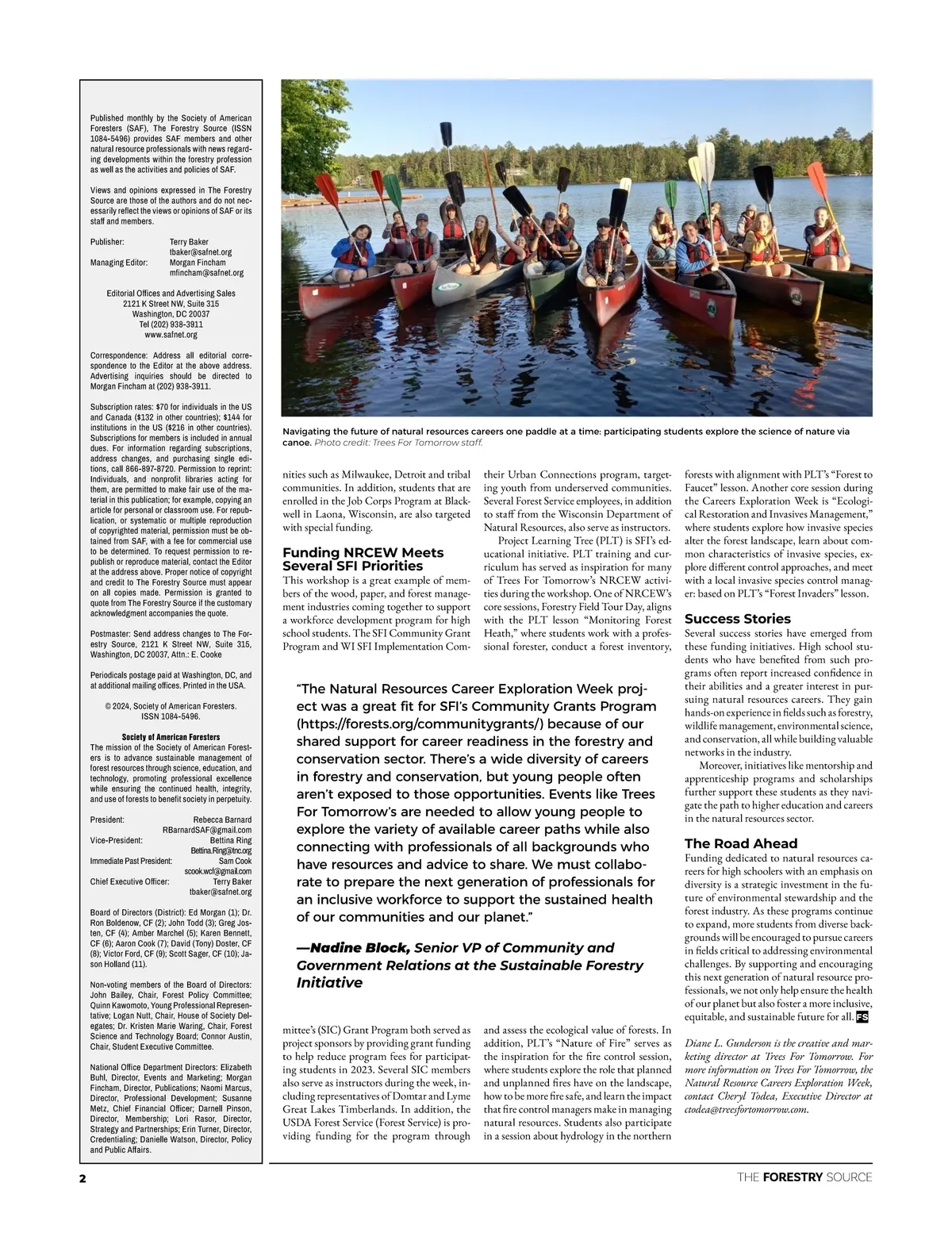
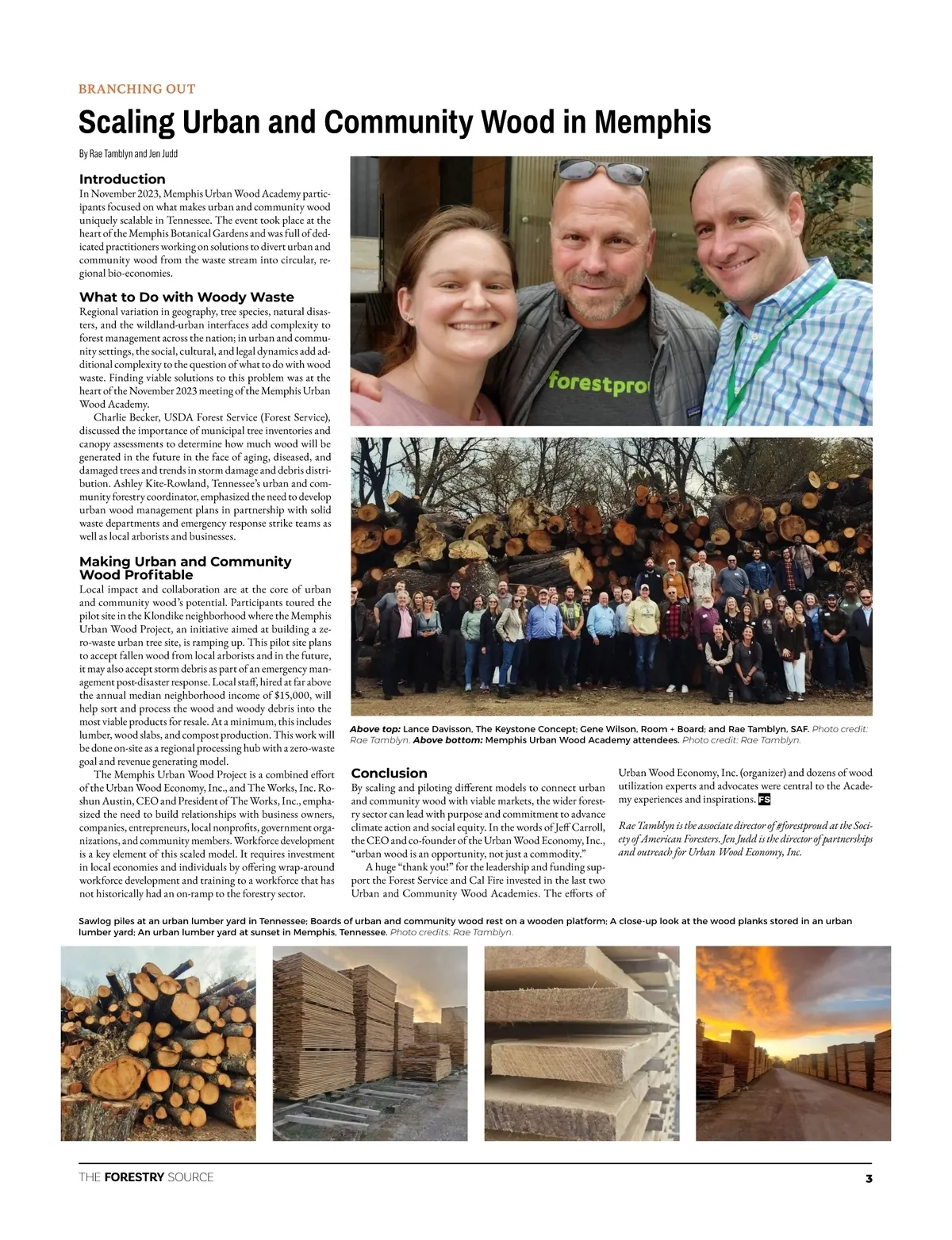
BRANCHING OUT Scaling Urban and Community Wood in Memphis By Rae Tamblyn and Jen Judd Introduction In November 2023, Memphis Urban Wood Academy partic -ipants focused on what makes urban and community wood uniquely scalable in Tennessee. The event took place at the heart of the Memphis Botanical Gardens and was full of ded -icated practitioners working on solutions to divert urban and community wood from the waste stream into circular, re -gional bio-economies. What to Do with Woody Waste Regional variation in geography, tree species, natural disas -ters, and the wildland-urban interfaces add complexity to forest management across the nation; in urban and commu -nity settings, the social, cultural, and legal dynamics add ad -ditional complexity to the question of what to do with wood waste. Finding viable solutions to this problem was at the heart of the November 2023 meeting of the Memphis Urban Wood Academy. Charlie Becker, USDA Forest Service (Forest Service), discussed the importance of municipal tree inventories and canopy assessments to determine how much wood will be generated in the future in the face of aging, diseased, and damaged trees and trends in storm damage and debris distri -bution. Ashley Kite-Rowland, Tennessee’s urban and com -munity forestry coordinator, emphasized the need to develop urban wood management plans in partnership with solid waste departments and emergency response strike teams as well as local arborists and businesses. Making Urban and Community Wood Profitable Local impact and collaboration are at the core of urban and community wood’s potential. Participants toured the pilot site in the Klondike neighborhood where the Memphis Urban Wood Project, an initiative aimed at building a ze -ro-waste urban tree site, is ramping up. This pilot site plans to accept fallen wood from local arborists and in the future, it may also accept storm debris as part of an emergency man -agement post-disaster response. Local staff, hired at far above the annual median neighborhood income of $15,000, will help sort and process the wood and woody debris into the most viable products for resale. At a minimum, this includes lumber, wood slabs, and compost production. This work will be done on-site as a regional processing hub with a zero-waste goal and revenue generating model. The Memphis Urban Wood Project is a combined effort of the Urban Wood Economy, Inc., and The Works, Inc. Ro -shun Austin, CEO and President of The Works, Inc., empha -sized the need to build relationships with business owners, companies, entrepreneurs, local nonprofits, government orga -nizations, and community members. Workforce development is a key element of this scaled model. It requires investment in local economies and individuals by offering wrap-around workforce development and training to a workforce that has not historically had an on-ramp to the forestry sector. Above top: Lance Davisson, The Keystone Concept; Gene Wilson, Room + Board; and Rae Tamblyn, SAF. Photo credit: Rae Tamblyn. Above bottom: Memphis Urban Wood Academy attendees. Photo credit: Rae Tamblyn. Conclusion By scaling and piloting different models to connect urban and community wood with viable markets, the wider forest -ry sector can lead with purpose and commitment to advance climate action and social equity. In the words of Jeff Carroll, the CEO and co-founder of the Urban Wood Economy, Inc., “urban wood is an opportunity, not just a commodity.” A huge “thank you!” for the leadership and funding sup -port the Forest Service and Cal Fire invested in the last two Urban and Community Wood Academies. The efforts of Urban Wood Economy, Inc. (organizer) and dozens of wood utilization experts and advocates were central to the Acade -my experiences and inspirations. FS Rae Tamblyn is the associate director of #forestproud at the Soci-ety of American Foresters. Jen Judd is the director of partnerships and outreach for Urban Wood Economy, Inc. Sawlog piles at an urban lumber yard in Tennessee; Boards of urban and community wood rest on a wooden platform; A close-up look at the wood planks stored in an urban lumber yard; An urban lumber yard at sunset in Memphis, Tennessee. Photo credits: Rae Tamblyn. THE FORESTRY SOURCE 3
The Forestry Source April 2024: Page 3