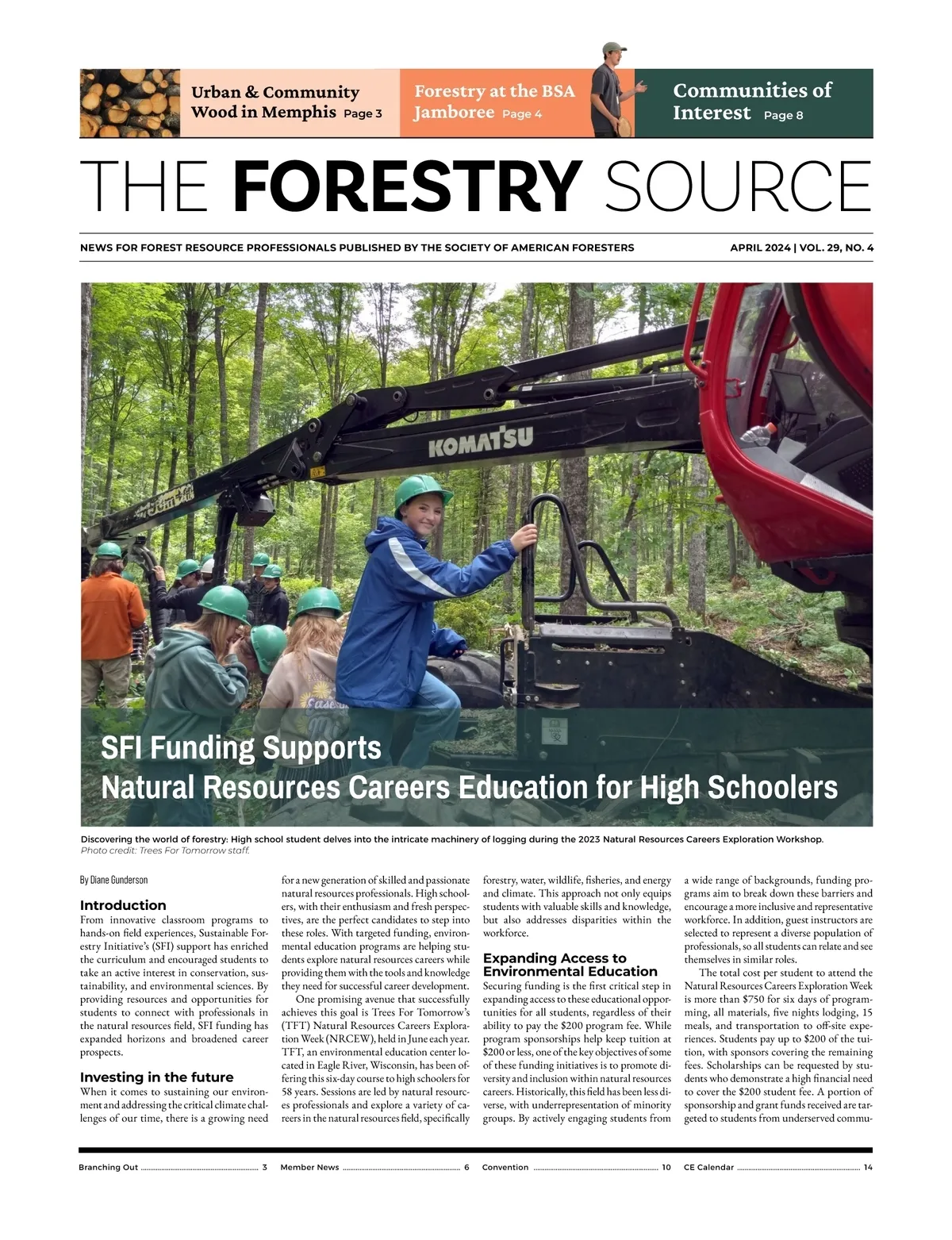
Urban & Community Wood in Memphis Page 3 Forestry at the BSA Jamboree Page 4 Communities of Interest Page 8 THE FORESTRY SOURCE NEWS FOR FOREST RESOURCE PROFESSIONALS PUBLISHED BY THE SOCIETY OF AMERICAN FORESTERS APRIL 2024 | VOL. 29, NO. 4 SFI Funding Supports Natural Resources Careers Education for High Schoolers Discovering the world of forestry: High school student delves into the intricate machinery of logging during the 2023 Natural Resources Careers Exploration Workshop. Photo credit: Trees For Tomorrow staff. By Diane Gunderson Introduction From innovative classroom programs to hands-on field experiences, Sustainable For -estry Initiative’s (SFI) support has enriched the curriculum and encouraged students to take an active interest in conservation, sus -tainability, and environmental sciences. By providing resources and opportunities for students to connect with professionals in the natural resources field, SFI funding has expanded horizons and broadened career prospects. Investing in the future When it comes to sustaining our environ -ment and addressing the critical climate chal-lenges of our time, there is a growing need for a new generation of skilled and passionate natural resources professionals. High school -ers, with their enthusiasm and fresh perspec -tives, are the perfect candidates to step into these roles. With targeted funding, environ -mental education programs are helping stu -dents explore natural resources careers while providing them with the tools and knowledge they need for successful career development. One promising avenue that successfully achieves this goal is Trees For Tomorrow’s (TFT) Natural Resources Careers Explora -tion Week (NRCEW), held in June each year. TFT, an environmental education center lo -cated in Eagle River, Wisconsin, has been of -fering this six-day course to high schoolers for 58 years. Sessions are led by natural resourc -es professionals and explore a variety of ca -reers in the natural resources field, specifically forestry, water, wildlife, fisheries, and energy and climate. This approach not only equips students with valuable skills and knowledge, but also addresses disparities within the workforce. Expanding Access to Environmental Education Securing funding is the first critical step in expanding access to these educational oppor -tunities for all students, regardless of their ability to pay the $200 program fee. While program sponsorships help keep tuition at $200 or less, one of the key objectives of some of these funding initiatives is to promote di -versity and inclusion within natural resources careers. Historically, this field has been less di -verse, with underrepresentation of minority groups. By actively engaging students from a wide range of backgrounds, funding pro -grams aim to break down these barriers and encourage a more inclusive and representative workforce. In addition, guest instructors are selected to represent a diverse population of professionals, so all students can relate and see themselves in similar roles. The total cost per student to attend the Natural Resources Careers Exploration Week is more than $750 for six days of program -ming, all materials, five nights lodging, 15 meals, and transportation to off-site expe -riences. Students pay up to $200 of the tui -tion, with sponsors covering the remaining fees. Scholarships can be requested by stu -dents who demonstrate a high financial need to cover the $200 student fee. A portion of sponsorship and grant funds received are tar -geted to students from underserved commu -Branching Out ................................................................ 3 Member News ................................................................ 6 Convention .................................................................... 10 CE Calendar ................................................................... 14
The Forestry Source April 2024: Page 1