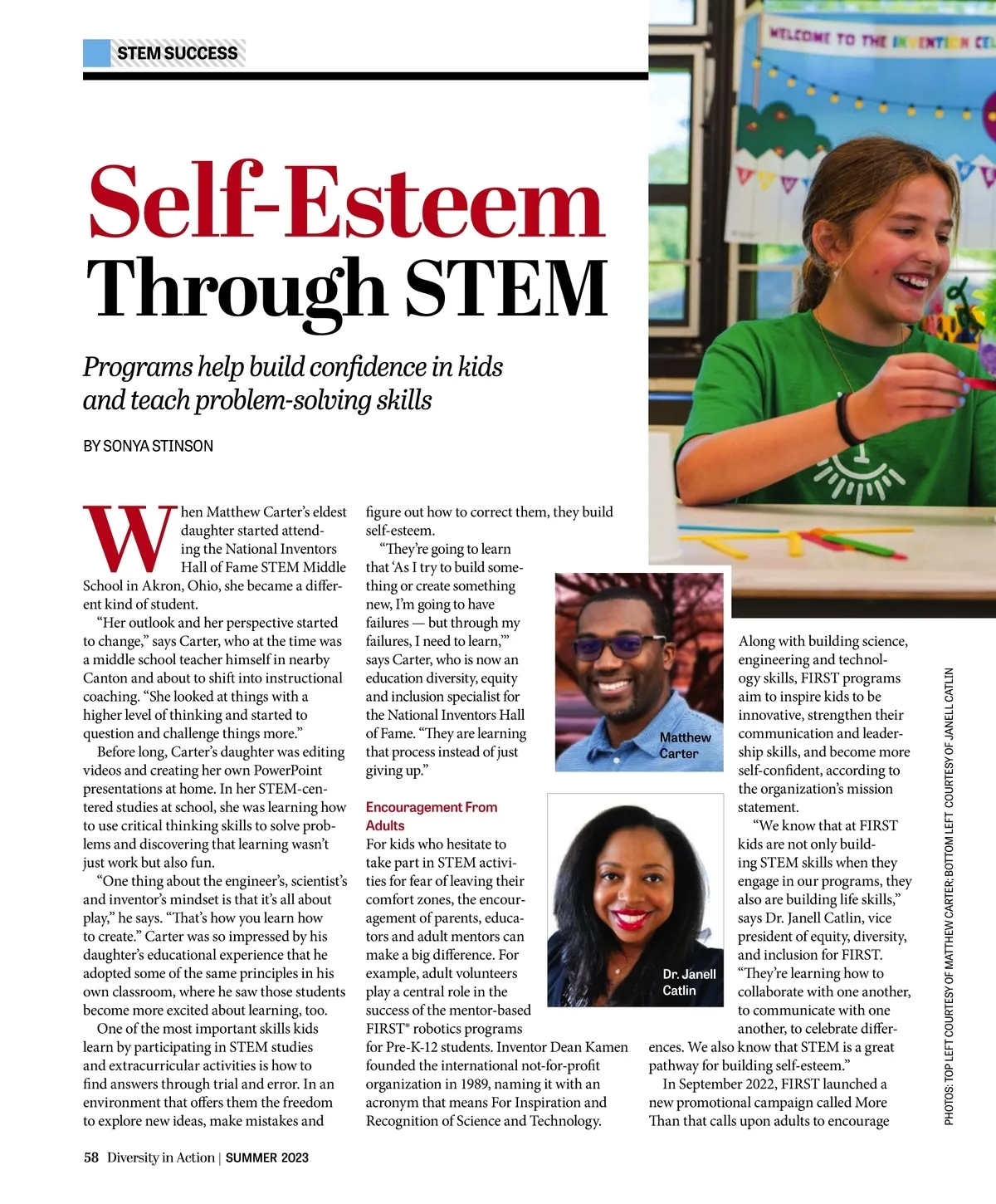
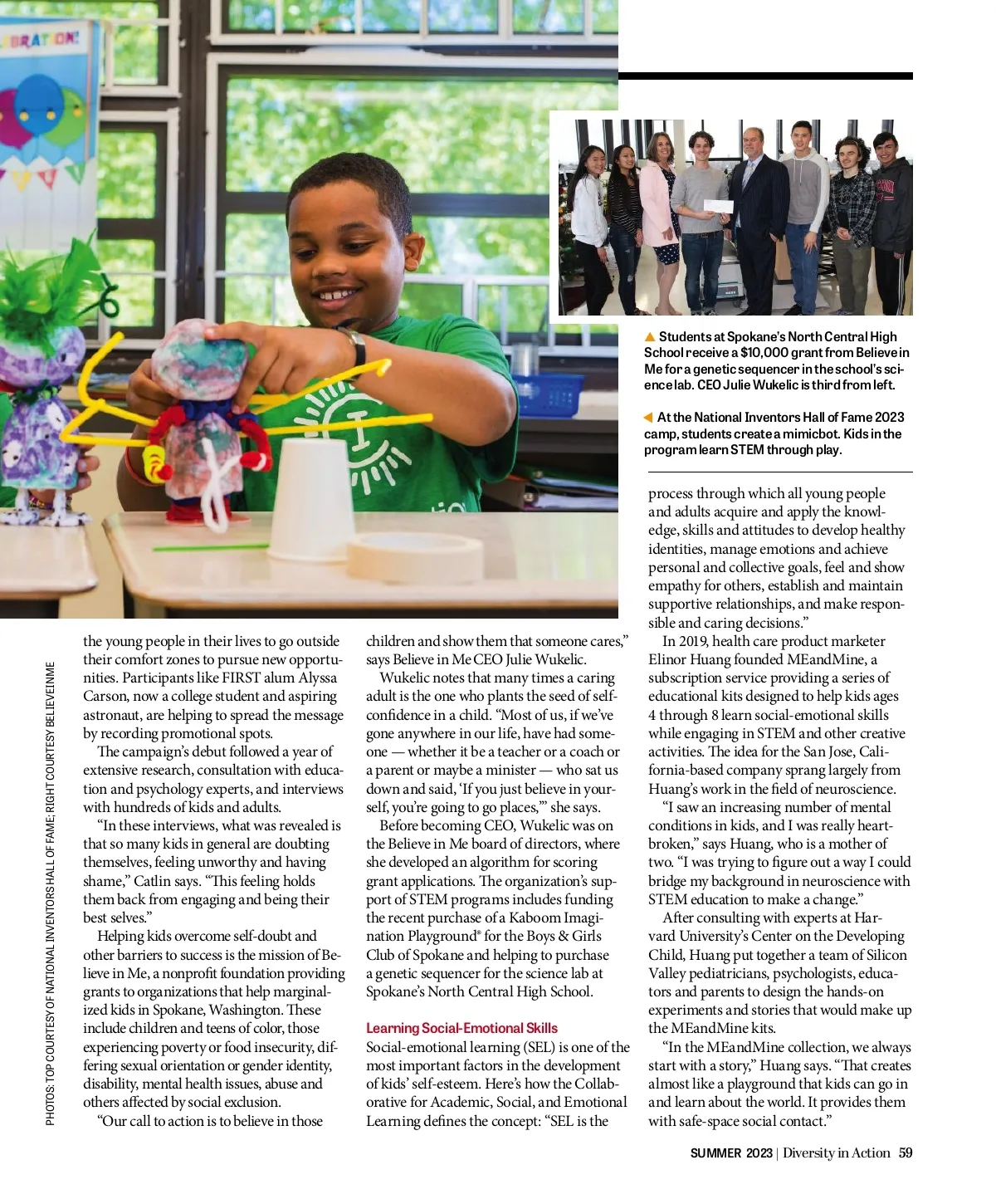
Students at Spokane’s North Central High School receive a $10,000 grant from Believe in Me for a genetic sequencer in the school’s sci-ence lab. CEO Julie Wukelic is third from left. At the National Inventors Hall of Fame 2023 camp, students create a mimicbot. Kids in the program learn STEM through play. the young people in their lives to go outside their comfort zones to pursue new opportu-nities. Participants like FIRST alum Alyssa Carson, now a college student and aspiring astronaut, are helping to spread the message by recording promotional spots. The campaign’s debut followed a year of extensive research, consultation with educa-tion and psychology experts, and interviews with hundreds of kids and adults. “In these interviews, what was revealed is that so many kids in general are doubting themselves, feeling unworthy and having shame,” Catlin says. “This feeling holds them back from engaging and being their best selves.” Helping kids overcome self-doubt and other barriers to success is the mission of Be-lieve in Me, a nonprofit foundation providing grants to organizations that help marginal-ized kids in Spokane, Washington. These include children and teens of color, those experiencing poverty or food insecurity, dif-fering sexual orientation or gender identity, disability, mental health issues, abuse and others affected by social exclusion. “Our call to action is to believe in those PHOTOS: TOP COURTESY OF NATIONAL INVENTORS HALL OF FAME; RIGHT COURTESY BELIEVEINME children and show them that someone cares,” says Believe in Me CEO Julie Wukelic. Wukelic notes that many times a caring adult is the one who plants the seed of self-confidence in a child. “Most of us, if we’ve gone anywhere in our life, have had some-one — whether it be a teacher or a coach or a parent or maybe a minister — who sat us down and said, ‘If you just believe in your-self, you’re going to go places,’” she says. Before becoming CEO, Wukelic was on the Believe in Me board of directors, where she developed an algorithm for scoring grant applications. The organization’s sup-port of STEM programs includes funding the recent purchase of a Kaboom Imagi-nation Playground® for the Boys & Girls Club of Spokane and helping to purchase a genetic sequencer for the science lab at Spokane’s North Central High School. Learning Social-Emotional Skills Social-emotional learning (SEL) is one of the most important factors in the development of kids’ self-esteem. Here’s how the Collab-orative for Academic, Social, and Emotional Learning defines the concept: “SEL is the process through which all young people and adults acquire and apply the knowl-edge, skills and attitudes to develop healthy identities, manage emotions and achieve personal and collective goals, feel and show empathy for others, establish and maintain supportive relationships, and make respon-sible and caring decisions.” In 2019, health care product marketer Elinor Huang founded MEandMine, a subscription service providing a series of educational kits designed to help kids ages 4 through 8 learn social-emotional skills while engaging in STEM and other creative activities. The idea for the San Jose, Cali-fornia-based company sprang largely from Huang’s work in the field of neuroscience. “I saw an increasing number of mental conditions in kids, and I was really heart-broken,” says Huang, who is a mother of two. “I was trying to figure out a way I could bridge my background in neuroscience with STEM education to make a change.” After consulting with experts at Har-vard University’s Center on the Developing Child, Huang put together a team of Silicon Valley pediatricians, psychologists, educa-tors and parents to design the hands-on experiments and stories that would make up the MEandMine kits. “In the MEandMine collection, we always start with a story,” Huang says. “That creates almost like a playground that kids can go in and learn about the world. It provides them with safe-space social contact.” SUMMER 2023 | Diversity in Action 59
Diversity in Action Summer 2023: Page 61