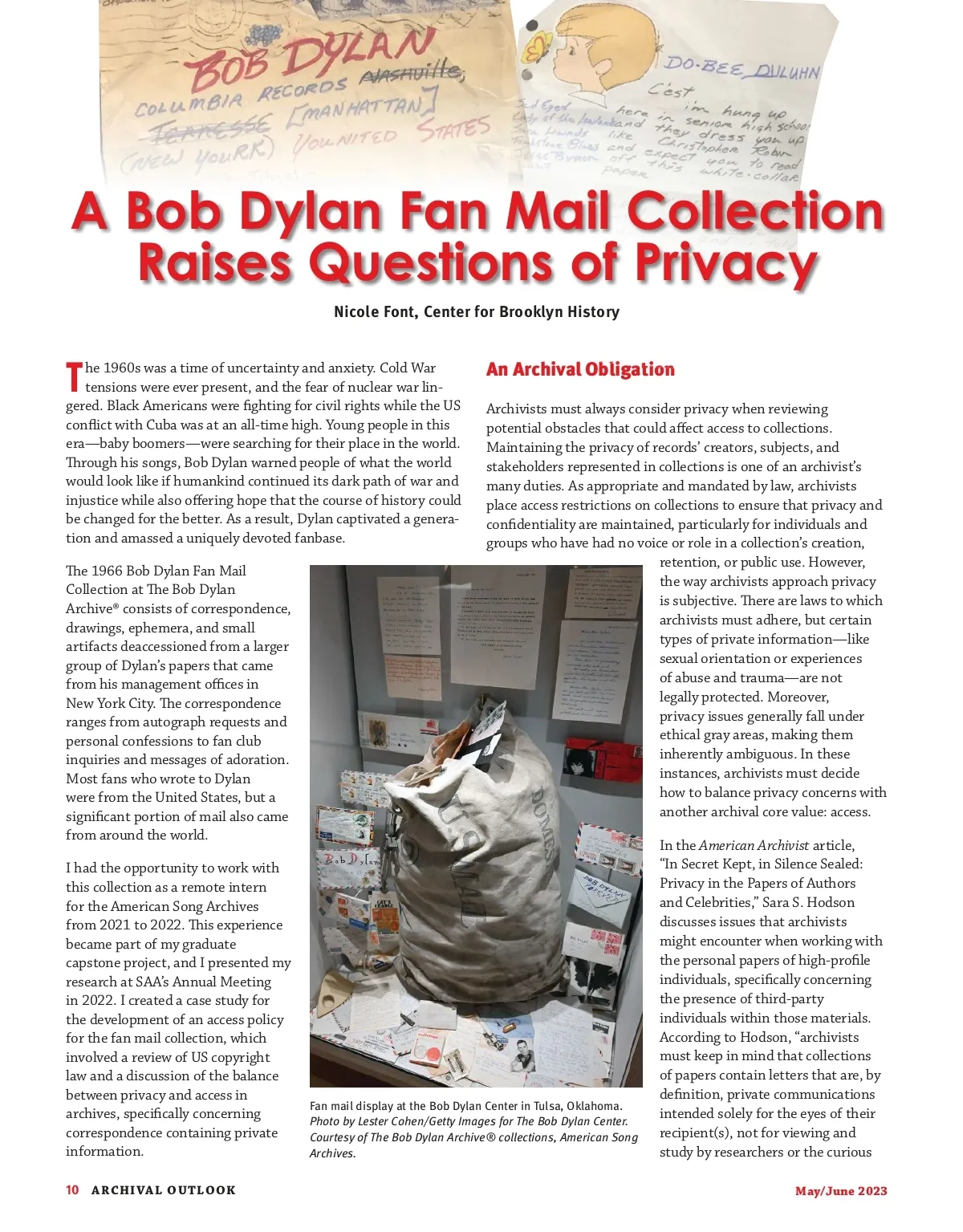
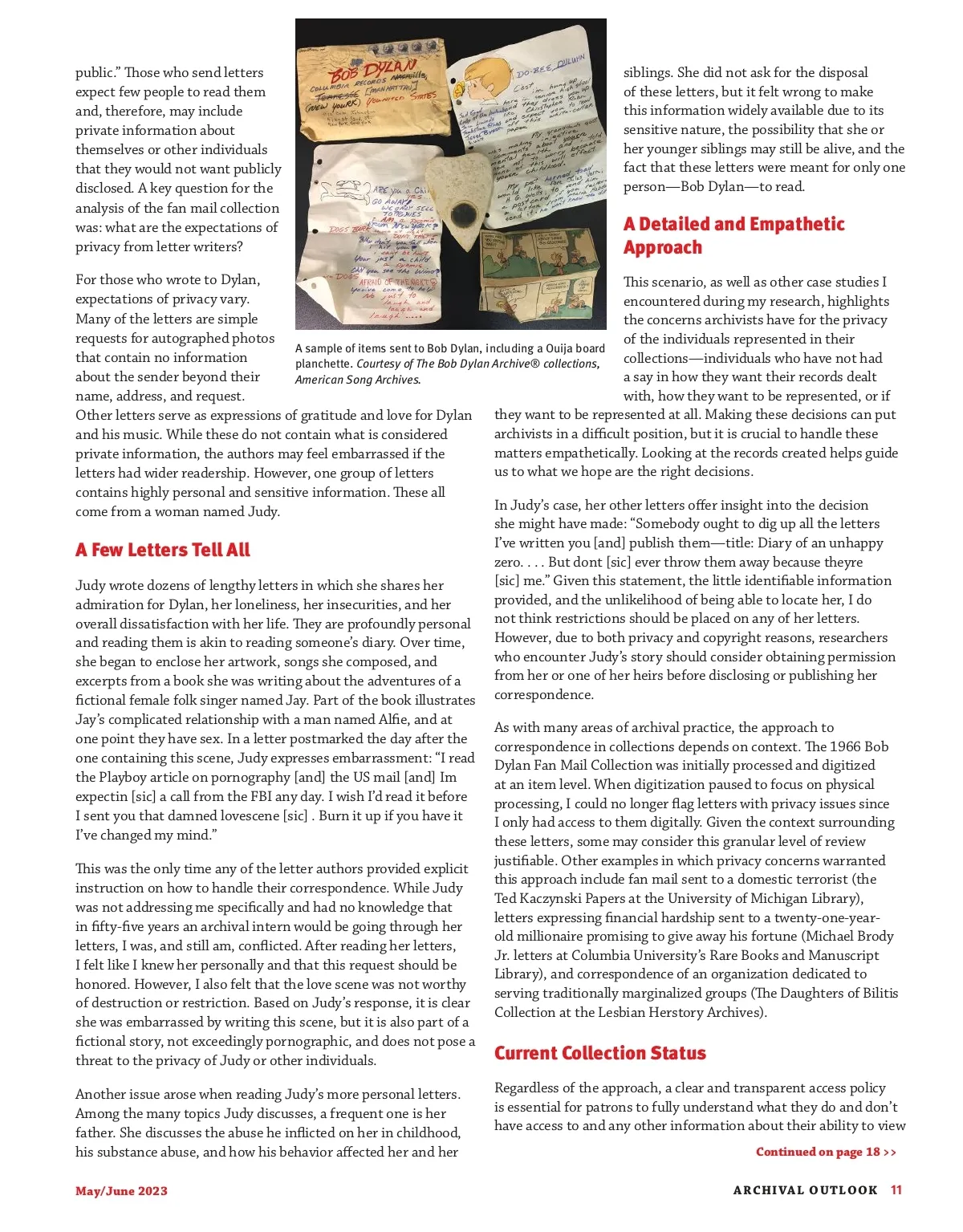
public.” Those who send letters expect few people to read them and, therefore, may include private information about themselves or other individuals that they would not want publicly disclosed. A key question for the analysis of the fan mail collection was: what are the expectations of privacy from letter writers? siblings. She did not ask for the disposal of these letters, but it felt wrong to make this information widely available due to its sensitive nature, the possibility that she or her younger siblings may still be alive, and the fact that these letters were meant for only one person—Bob Dylan—to read. A Detailed and Empathetic Approach For those who wrote to Dylan, This scenario, as well as other case studies I expectations of privacy vary. encountered during my research, highlights Many of the letters are simple the concerns archivists have for the privacy requests for autographed photos of the individuals represented in their A sample of items sent to Bob Dylan, including a Ouija board that contain no information collections—individuals who have not had planchette. Courtesy of The Bob Dylan Archive® collections, about the sender beyond their a say in how they want their records dealt American Song Archives. name, address, and request. with, how they want to be represented, or if Other letters serve as expressions of gratitude and love for Dylan they want to be represented at all. Making these decisions can put archivists in a difficult position, but it is crucial to handle these and his music. While these do not contain what is considered matters empathetically. Looking at the records created helps guide private information, the authors may feel embarrassed if the us to what we hope are the right decisions. letters had wider readership. However, one group of letters contains highly personal and sensitive information. These all In Judy’s case, her other letters offer insight into the decision come from a woman named Judy. she might have made: “Somebody ought to dig up all the letters I’ve written you [and] publish them—title: Diary of an unhappy A Few Letters Tell All zero. . . . But dont [sic] ever throw them away because theyre [sic] me.” Given this statement, the little identifiable information Judy wrote dozens of lengthy letters in which she shares her provided, and the unlikelihood of being able to locate her, I do admiration for Dylan, her loneliness, her insecurities, and her not think restrictions should be placed on any of her letters. overall dissatisfaction with her life. They are profoundly personal However, due to both privacy and copyright reasons, researchers and reading them is akin to reading someone’s diary. Over time, who encounter Judy’s story should consider obtaining permission she began to enclose her artwork, songs she composed, and from her or one of her heirs before disclosing or publishing her excerpts from a book she was writing about the adventures of a fictional female folk singer named Jay. Part of the book illustrates correspondence. Jay’s complicated relationship with a man named Alfie, and at one point they have sex. In a letter postmarked the day after the one containing this scene, Judy expresses embarrassment: “I read the Playboy article on pornography [and] the US mail [and] Im expectin [sic] a call from the FBI any day. I wish I’d read it before I sent you that damned lovescene [sic] . Burn it up if you have it I’ve changed my mind.” This was the only time any of the letter authors provided explicit instruction on how to handle their correspondence. While Judy was not addressing me specifically and had no knowledge that in fifty-five years an archival intern would be going through her letters, I was, and still am, conflicted. After reading her letters, I felt like I knew her personally and that this request should be honored. However, I also felt that the love scene was not worthy of destruction or restriction. Based on Judy’s response, it is clear she was embarrassed by writing this scene, but it is also part of a fictional story, not exceedingly pornographic, and does not pose a threat to the privacy of Judy or other individuals. Another issue arose when reading Judy’s more personal letters. Among the many topics Judy discusses, a frequent one is her father. She discusses the abuse he inflicted on her in childhood, his substance abuse, and how his behavior affected her and her May/June 2023 As with many areas of archival practice, the approach to correspondence in collections depends on context. The 1966 Bob Dylan Fan Mail Collection was initially processed and digitized at an item level. When digitization paused to focus on physical processing, I could no longer flag letters with privacy issues since I only had access to them digitally. Given the context surrounding these letters, some may consider this granular level of review justifiable. Other examples in which privacy concerns warranted this approach include fan mail sent to a domestic terrorist (the Ted Kaczynski Papers at the University of Michigan Library), letters expressing financial hardship sent to a twenty-one-year-old millionaire promising to give away his fortune (Michael Brody Jr. letters at Columbia University’s Rare Books and Manuscript Library), and correspondence of an organization dedicated to serving traditionally marginalized groups (The Daughters of Bilitis Collection at the Lesbian Herstory Archives). Current Collection Status Regardless of the approach, a clear and transparent access policy is essential for patrons to fully understand what they do and don’t have access to and any other information about their ability to view Continued on page 18 >> ARCHIVAL OUTLOOK 11
Archival Outlook May/June 2023: Page 11