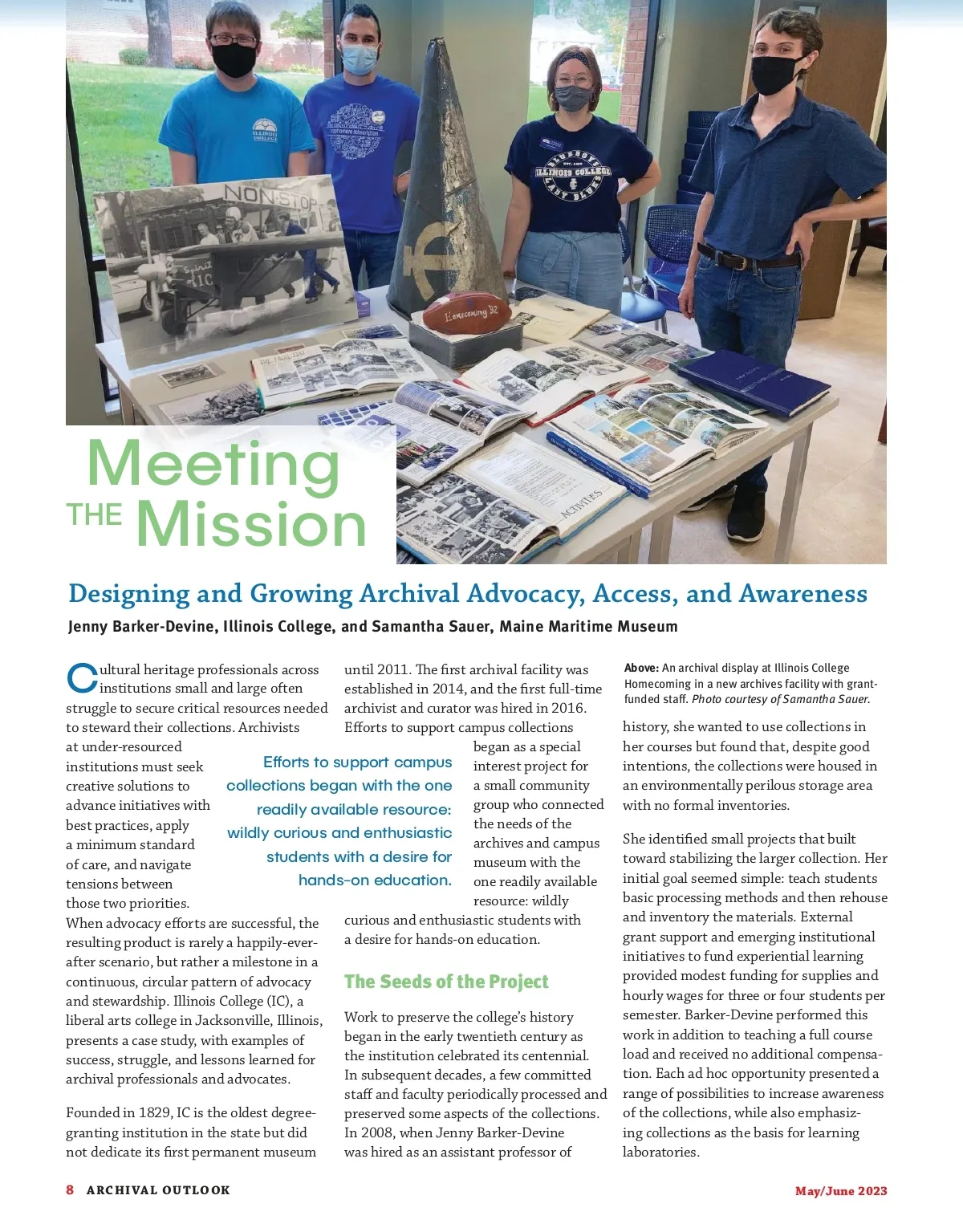
Over the next few years, the campus and community took interest in the project, with increasing demand to access and donate materials. As the project evolved, Barker-Devine understood that the collections needed expert attention. Her advocacy opened conversations with site administrators, and in 2014 they secured a National Endowment for the Humanities (NEH) Challenge grant. The grant supported construction of a new climate and access-controlled facility, as well as initial funding for internal and external scholarship and partial funding for a permanent steward. The grant did not include general operational or administrative support. In 2015, a national search identified Samantha Sauer as the inaugural leader of the museum and archives, in an administrative-faculty and non-tenure track role. with a backlog of two centuries of college history, there was much to do. While NEH grant funding provided a foundation for action and implementation, next steps required mindful prioritization due to limited operational and institutional support. Sauer focused strategic planning on establishing and implementing best practices, fulfilling new NEH grant requirements, and, in alignment with the parent institution’s mission, advancing student success. Sauer quickly collaborated with campus units to formalize student engagement through both paid and credit-based experiential learning opportunities. Student-centered initiatives were designed to meet immediate needs for engagement while also considering long-term strategic planning. Sauer developed and led appropriate recruitment, training, and mentoring to support daily operations of the museum and archives, while also creating capacity to increase visibility of the collections with scholarship, research, and teaching. One early student project focused on appraising institutional publications, such as the college yearbook. Project architecture expanded with collection needs, soon including interdisciplinary scholarship focused on collections development and preservation. Student engagement included community partnerships and outreach initiatives, such as a collections development to identify and address missing materials in records of traditionally underrepresented student organizations. Fostering Awareness and Student Advocates By firmly positioning students as stakeholders, Sauer empowered them with resources and encouragement to serve as highly visible and impassioned advocates. Sauer documented and communicated progress to increase community awareness, as well as to meet ongoing grant reporting requirements. Sustaining successful student engagement required both enthusiasm and endurance. Sauer called upon local, state, regional, and national cultural heritage networks, colleagues, and professional organizations Continued on page 17>> Growing the Program After surveying institutional challenges and needs, Sauer developed an administrative structure that prioritized access, engagement, and capacity-building. With Barker-Devine’s momentum in place, there was significant potential, and May/June 2023 ARCHIVAL OUTLOOK 9
Archival Outlook May/June 2023: Page 9