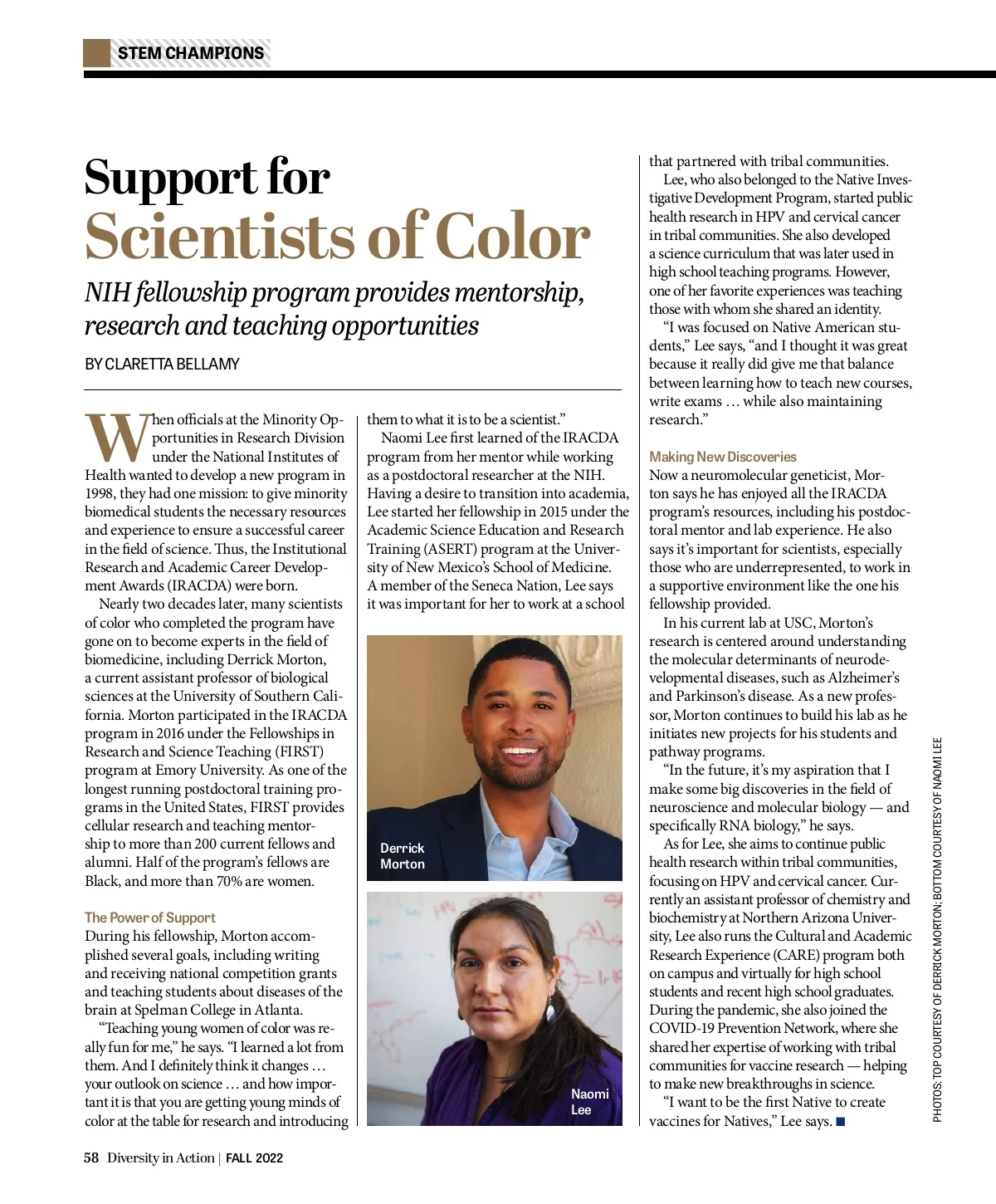
STEM CHAMPIONS Support for Scientists of Color NIH fellowship program provides mentorship, research and teaching opportunities BY CLARETTA BELLAMY hen officials at the Minority Op-portunities in Research Division under the National Institutes of Health wanted to develop a new program in 1998, they had one mission: to give minority biomedical students the necessary resources and experience to ensure a successful career in the field of science. Thus, the Institutional Research and Academic Career Develop-ment Awards (IRACDA) were born. Nearly two decades later, many scientists of color who completed the program have gone on to become experts in the field of biomedicine, including Derrick Morton, a current assistant professor of biological sciences at the University of Southern Cali-fornia. Morton participated in the IRACDA program in 2016 under the Fellowships in Research and Science Teaching (FIRST) program at Emory University. As one of the longest running postdoctoral training pro-grams in the United States, FIRST provides cellular research and teaching mentor-ship to more than 200 current fellows and alumni. Half of the program’s fellows are Black, and more than 70% are women. The Power of Support W them to what it is to be a scientist.” Naomi Lee first learned of the IRACDA program from her mentor while working as a postdoctoral researcher at the NIH. Having a desire to transition into academia, Lee started her fellowship in 2015 under the Academic Science Education and Research Training (ASERT) program at the Univer-sity of New Mexico’s School of Medicine. A member of the Seneca Nation, Lee says it was important for her to work at a school that partnered with tribal communities. Lee, who also belonged to the Native Inves-tigative Development Program, started public health research in HPV and cervical cancer in tribal communities. She also developed a science curriculum that was later used in high school teaching programs. However, one of her favorite experiences was teaching those with whom she shared an identity. “I was focused on Native American stu-dents,” Lee says, “and I thought it was great because it really did give me that balance between learning how to teach new courses, write exams … while also maintaining research.” Making New Discoveries Derrick Morton During his fellowship, Morton accom-plished several goals, including writing and receiving national competition grants and teaching students about diseases of the brain at Spelman College in Atlanta. “Teaching young women of color was re-ally fun for me,” he says. “I learned a lot from them. And I definitely think it changes … your outlook on science … and how impor-tant it is that you are getting young minds of color at the table for research and introducing 58 Diversity in Action | FALL 2022 Naomi Lee Now a neuromolecular geneticist, Mor-ton says he has enjoyed all the IRACDA program’s resources, including his postdoc-toral mentor and lab experience. He also says it’s important for scientists, especially those who are underrepresented, to work in a supportive environment like the one his fellowship provided. In his current lab at USC, Morton’s research is centered around understanding the molecular determinants of neurode-velopmental diseases, such as Alzheimer’s and Parkinson’s disease. As a new profes-sor, Morton continues to build his lab as he initiates new projects for his students and pathway programs. “In the future, it’s my aspiration that I make some big discoveries in the field of neuroscience and molecular biology — and specifically RNA biology,” he says. As for Lee, she aims to continue public health research within tribal communities, focusing on HPV and cervical cancer. Cur-rently an assistant professor of chemistry and biochemistry at Northern Arizona Univer-sity, Lee also runs the Cultural and Academic Research Experience (CARE) program both on campus and virtually for high school students and recent high school graduates. During the pandemic, she also joined the COVID-19 Prevention Network, where she shared her expertise of working with tribal communities for vaccine research — helping to make new breakthroughs in science. “I want to be the first Native to create vaccines for Natives,” Lee says. n PHOTOS: TOP COURTESY OF DERRICK MORTON; BOTTOM COURTESY OF NAOMI LEE
Diversity in Action Fall 2022: Page 58