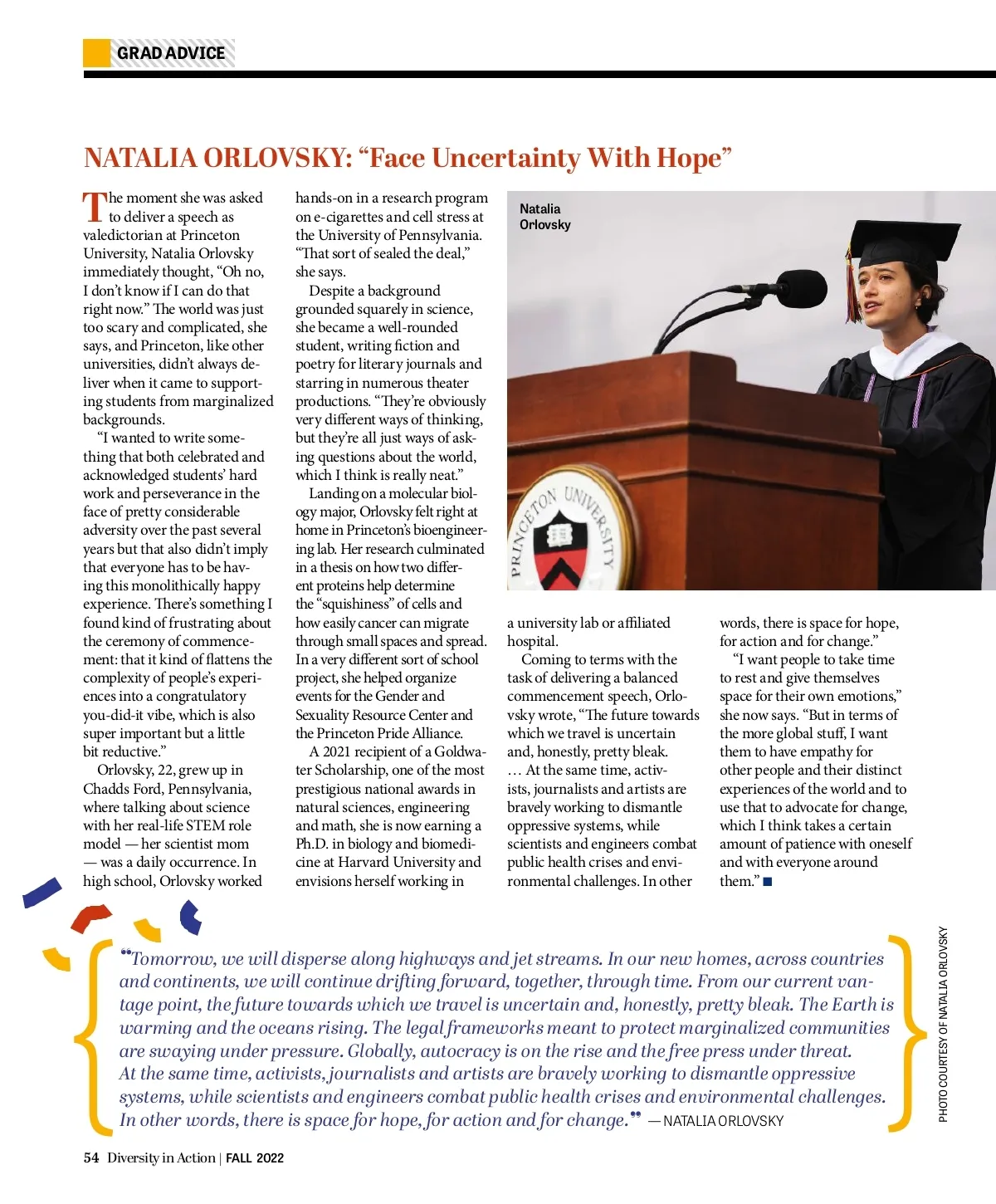
GRAD ADVICE T NATALIA ORLOVSKY: “Face Uncertainty With Hope” hands-on in a research program on e-cigarettes and cell stress at the University of Pennsylvania. “That sort of sealed the deal,” she says. Despite a background grounded squarely in science, she became a well-rounded student, writing fiction and poetry for literary journals and starring in numerous theater productions. “They’re obviously very different ways of thinking, but they’re all just ways of ask-ing questions about the world, which I think is really neat.” Landing on a molecular biol-ogy major, Orlovsky felt right at home in Princeton’s bioengineer-ing lab. Her research culminated in a thesis on how two differ-ent proteins help determine the “squishiness” of cells and how easily cancer can migrate through small spaces and spread. In a very different sort of school project, she helped organize events for the Gender and Sexuality Resource Center and the Princeton Pride Alliance. A 2021 recipient of a Goldwa-ter Scholarship, one of the most prestigious national awards in natural sciences, engineering and math, she is now earning a Ph.D. in biology and biomedi-cine at Harvard University and envisions herself working in Natalia Orlovsky { he moment she was asked to deliver a speech as valedictorian at Princeton University, Natalia Orlovsky immediately thought, “Oh no, I don’t know if I can do that right now.” The world was just too scary and complicated, she says, and Princeton, like other universities, didn’t always de-liver when it came to support-ing students from marginalized backgrounds. “I wanted to write some-thing that both celebrated and acknowledged students’ hard work and perseverance in the face of pretty considerable adversity over the past several years but that also didn’t imply that everyone has to be hav-ing this monolithically happy experience. There’s something I found kind of frustrating about the ceremony of commence-ment: that it kind of flattens the complexity of people’s experi-ences into a congratulatory you-did-it vibe, which is also super important but a little bit reductive.” Orlovsky, 22, grew up in Chadds Ford, Pennsylvania, where talking about science with her real-life STEM role model — her scientist mom — was a daily occurrence. In high school, Orlovsky worked a university lab or affiliated hospital. Coming to terms with the task of delivering a balanced commencement speech, Orlo-vsky wrote, “The future towards which we travel is uncertain and, honestly, pretty bleak. … At the same time, activ-ists, journalists and artists are bravely working to dismantle oppressive systems, while scientists and engineers combat public health crises and envi-ronmental challenges. In other words, there is space for hope, for action and for change.” “I want people to take time to rest and give themselves space for their own emotions,” she now says. “But in terms of the more global stuff, I want them to have empathy for other people and their distinct experiences of the world and to use that to advocate for change, which I think takes a certain amount of patience with oneself and with everyone around them.” n “ Tomorrow, we will disperse along highways and jet streams. In our new homes, across countries and continents, we will continue drifting forward, together, through time. From our current van-tage point, the future towards which we travel is uncertain and, honestly, pretty bleak. The Earth is warming and the oceans rising. The legal frameworks meant to protect marginalized communities are swaying under pressure. Globally, autocracy is on the rise and the free press under threat. At the same time, activists, journalists and artists are bravely working to dismantle oppressive systems, while scientists and engineers combat public health crises and environmental challenges. In other words, there is space for hope, for action and for change. ” — NATALIA ORLOVSKY 54 Diversity in Action | FALL 2022 } PHOTO COURTESY OF NATALIA ORLOVSKY
Diversity in Action Fall 2022: Page 54