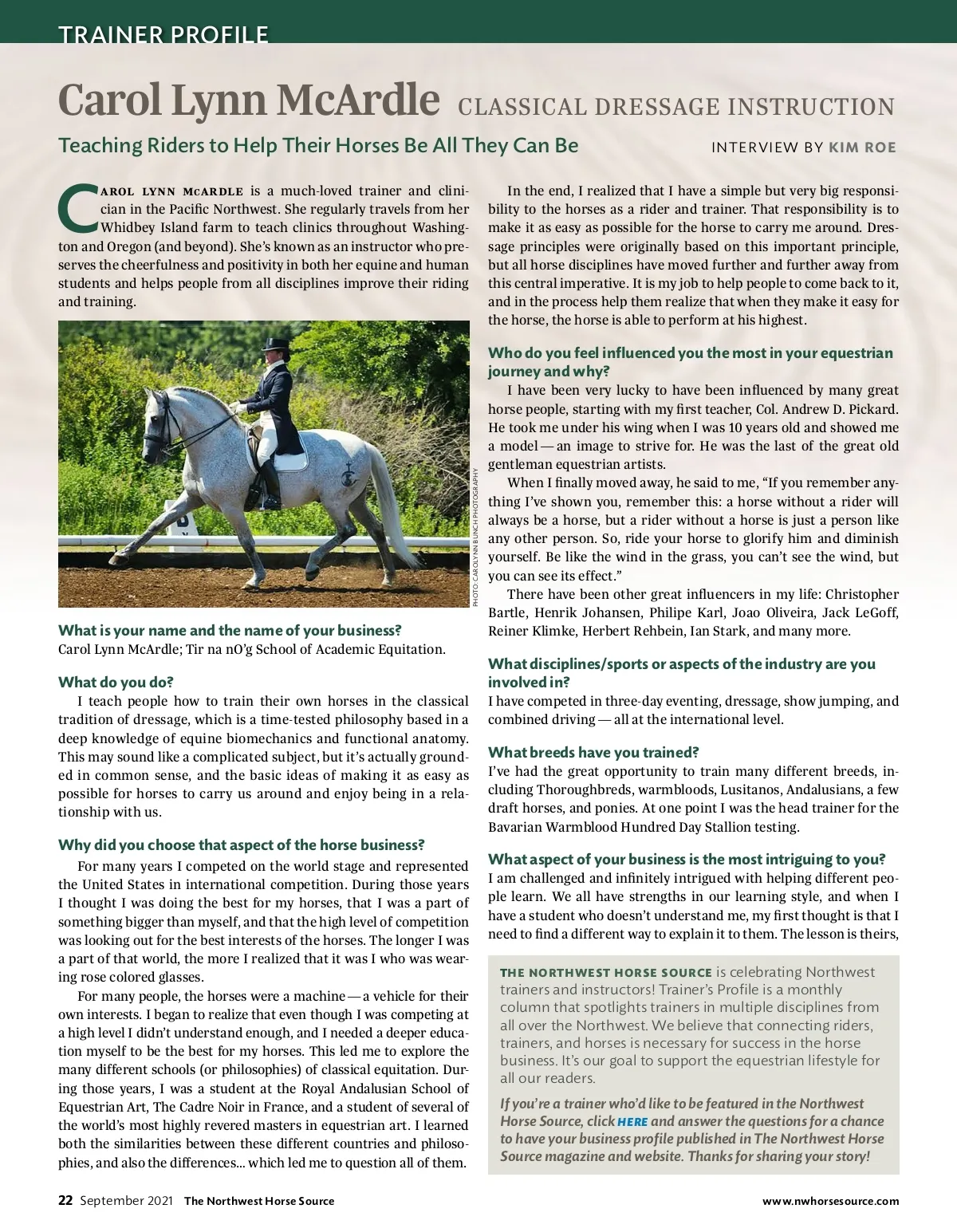
TRAINER PROFILE Carol Lynn McArdle CLASSICAL DRESSAGE INSTRUCTION INTERVIEW BY KIM ROE In the end, I realized that I have a simple but very big responsi-bility to the horses as a rider and trainer. That responsibility is to make it as easy as possible for the horse to carry me around. Dres-sage principles were originally based on this important principle, but all horse disciplines have moved further and further away from this central imperative. It is my job to help people to come back to it, and in the process help them realize that when they make it easy for the horse, the horse is able to perform at his highest. C Teaching Riders to Help Their Horses Be All They Can Be arol lynn m c ardle is a much-loved trainer and clini-cian in the Pacific Northwest. She regularly travels from her Whidbey Island farm to teach clinics throughout Washing-ton and Oregon (and beyond). She’s known as an instructor who pre-serves the cheerfulness and positivity in both her equine and human students and helps people from all disciplines improve their riding and training. Who do you feel influenced you the most in your equestrian journey and why? What is your name and the name of your business? What do you do? I have been very lucky to have been influenced by many great horse people, starting with my first teacher, Col. Andrew D. Pickard. He took me under his wing when I was 10 years old and showed me a model — an image to strive for. He was the last of the great old gentleman equestrian artists. When I finally moved away, he said to me, “If you remember any-thing I’ve shown you, remember this: a horse without a rider will always be a horse, but a rider without a horse is just a person like any other person. So, ride your horse to glorify him and diminish yourself. Be like the wind in the grass, you can’t see the wind, but you can see its effect.” There have been other great influencers in my life: Christopher Bartle, Henrik Johansen, Philipe Karl, Joao Oliveira, Jack LeGoff, Reiner Klimke, Herbert Rehbein, Ian Stark, and many more. Carol Lynn McArdle; Tir na nO’g School of Academic Equitation. I teach people how to train their own horses in the classical tradition of dressage, which is a time-tested philosophy based in a deep knowledge of equine biomechanics and functional anatomy. This may sound like a complicated subject, but it’s actually ground-ed in common sense, and the basic ideas of making it as easy as possible for horses to carry us around and enjoy being in a rela-tionship with us. PHOTO: CAROLYNN BUNCH PHOTOGRAPHY What disciplines/sports or aspects of the industry are you involved in? I have competed in three-day eventing, dressage, show jumping, and combined driving — all at the international level. What breeds have you trained? Why did you choose that aspect of the horse business? I’ve had the great opportunity to train many different breeds, in-cluding Thoroughbreds, warmbloods, Lusitanos, Andalusians, a few draft horses, and ponies. At one point I was the head trainer for the Bavarian Warmblood Hundred Day Stallion testing. For many years I competed on the world stage and represented the United States in international competition. During those years I thought I was doing the best for my horses, that I was a part of something bigger than myself, and that the high level of competition was looking out for the best interests of the horses. The longer I was a part of that world, the more I realized that it was I who was wear-ing rose colored glasses. For many people, the horses were a machine — a vehicle for their own interests. I began to realize that even though I was competing at a high level I didn’t understand enough, and I needed a deeper educa-tion myself to be the best for my horses. This led me to explore the many different schools (or philosophies) of classical equitation. Dur-ing those years, I was a student at the Royal Andalusian School of Equestrian Art, The Cadre Noir in France, and a student of several of the world’s most highly revered masters in equestrian art. I learned both the similarities between these different countries and philoso-phies, and also the differences… which led me to question all of them. 22 September 2021 The Northwest Horse Source What aspect of your business is the most intriguing to you? I am challenged and infinitely intrigued with helping different peo-ple learn. We all have strengths in our learning style, and when I have a student who doesn’t understand me, my first thought is that I need to find a different way to explain it to them. The lesson is theirs, the northwest horse source is celebrating Northwest trainers and instructors! Trainer’s Profile is a monthly column that spotlights trainers in multiple disciplines from all over the Northwest. We believe that connecting riders, trainers, and horses is necessary for success in the horse business. It’s our goal to support the equestrian lifestyle for all our readers. If you’re a trainer who’d like to be featured in the Northwest Horse Source, click here and answer the questions for a chance to have your business profile published in The Northwest Horse Source magazine and website. Thanks for sharing your story! www.nwhorsesource.com
The Northwest Horse Source NWHS 0921: Page 22