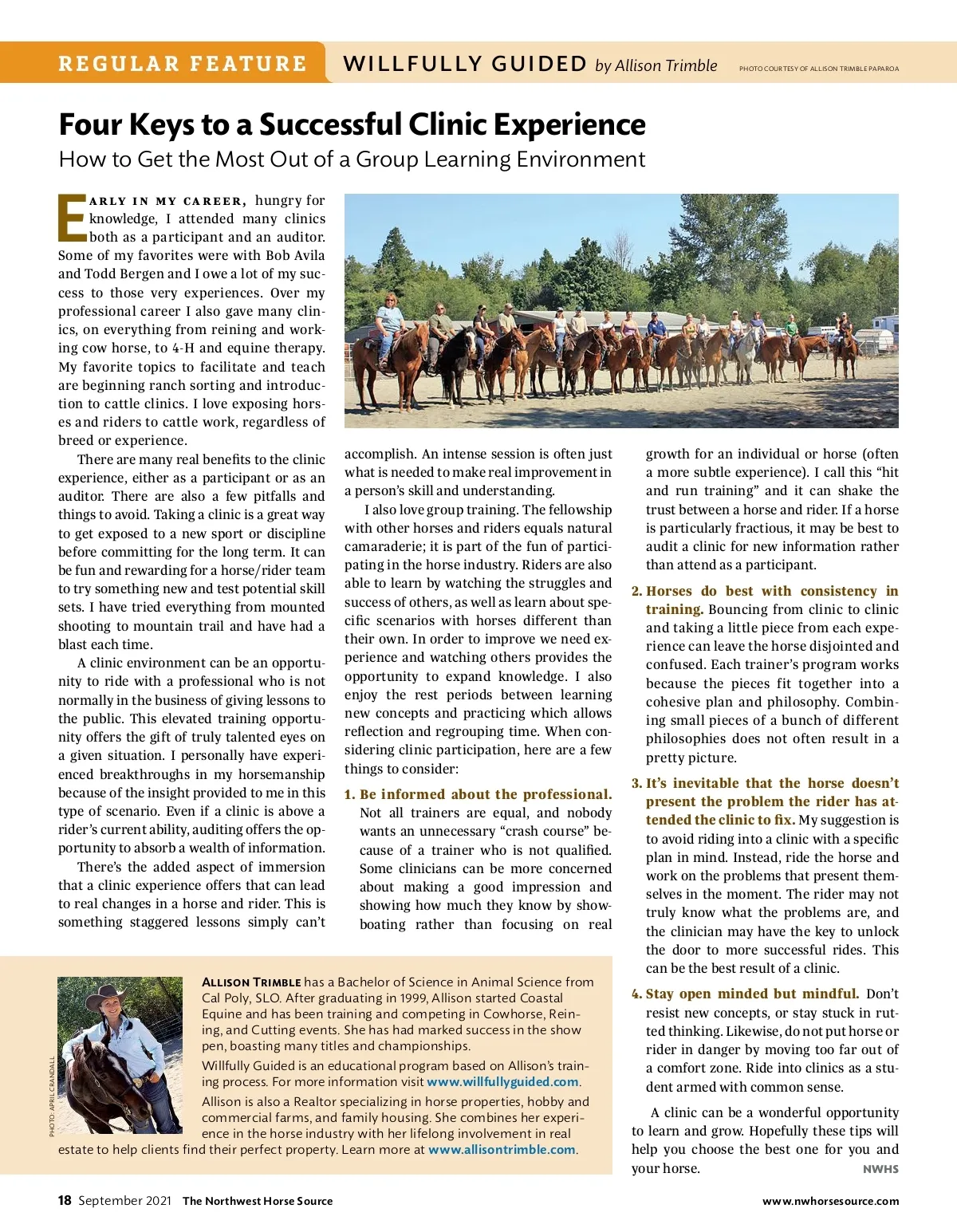
REGULAR FEATURE WILLFULLY GUIDED by Allison Trimble PHOTO COURTESY OF ALLISON TRIMBLE PAPAROA Four Keys to a Successful Clinic Experience E How to Get the Most Out of a Group Learning Environment arly in my career, hungry for knowledge, I attended many clinics both as a participant and an auditor. Some of my favorites were with Bob Avila and Todd Bergen and I owe a lot of my suc-cess to those very experiences. Over my professional career I also gave many clin-ics, on everything from reining and work-ing cow horse, to 4-H and equine therapy. My favorite topics to facilitate and teach are beginning ranch sorting and introduc-tion to cattle clinics. I love exposing hors-es and riders to cattle work, regardless of breed or experience. There are many real benefits to the clinic experience, either as a participant or as an auditor. There are also a few pitfalls and things to avoid. Taking a clinic is a great way to get exposed to a new sport or discipline before committing for the long term. It can be fun and rewarding for a horse/rider team to try something new and test potential skill sets. I have tried everything from mounted shooting to mountain trail and have had a blast each time. A clinic environment can be an opportu-nity to ride with a professional who is not normally in the business of giving lessons to the public. This elevated training opportu-nity offers the gift of truly talented eyes on a given situation. I personally have experi-enced breakthroughs in my horsemanship because of the insight provided to me in this type of scenario. Even if a clinic is above a rider’s current ability, auditing offers the op-portunity to absorb a wealth of information. There’s the added aspect of immersion that a clinic experience offers that can lead to real changes in a horse and rider. This is something staggered lessons simply can’t accomplish. An intense session is often just what is needed to make real improvement in a person’s skill and understanding. I also love group training. The fellowship with other horses and riders equals natural camaraderie; it is part of the fun of partici-pating in the horse industry. Riders are also able to learn by watching the struggles and success of others, as well as learn about spe-cific scenarios with horses different than their own. In order to improve we need ex-perience and watching others provides the opportunity to expand knowledge. I also enjoy the rest periods between learning new concepts and practicing which allows reflection and regrouping time. When con-sidering clinic participation, here are a few things to consider: 1. Be informed about the professional. Not all trainers are equal, and nobody wants an unnecessary “crash course” be-cause of a trainer who is not qualified. Some clinicians can be more concerned about making a good impression and showing how much they know by show-boating rather than focusing on real growth for an individual or horse (often a more subtle experience). I call this “hit and run training” and it can shake the trust between a horse and rider. If a horse is particularly fractious, it may be best to audit a clinic for new information rather than attend as a participant. 2. Horses do best with consistency in training. Bouncing from clinic to clinic and taking a little piece from each expe-rience can leave the horse disjointed and confused. Each trainer’s program works because the pieces fit together into a cohesive plan and philosophy. Combin-ing small pieces of a bunch of different philosophies does not often result in a pretty picture. 3. It’s inevitable that the horse doesn’t present the problem the rider has at-tended the clinic to fix. My suggestion is to avoid riding into a clinic with a specific plan in mind. Instead, ride the horse and work on the problems that present them-selves in the moment. The rider may not truly know what the problems are, and the clinician may have the key to unlock the door to more successful rides. This can be the best result of a clinic. 4. Stay open minded but mindful. Don’t resist new concepts, or stay stuck in rut-ted thinking. Likewise, do not put horse or rider in danger by moving too far out of a comfort zone. Ride into clinics as a stu-dent armed with common sense. A clinic can be a wonderful opportunity to learn and grow. Hopefully these tips will help you choose the best one for you and your horse. NWHS www.nwhorsesource.com PHOTO: APRIL CRANDALL Allison Trimble has a Bachelor of Science in Animal Science from Cal Poly, SLO. After graduating in 1999, Allison started Coastal Equine and has been training and competing in Cowhorse, Rein-ing, and Cutting events. She has had marked success in the show pen, boasting many titles and championships. Willfully Guided is an educational program based on Allison’s train-ing process. For more information visit www.willfullyguided.com . Allison is also a Realtor specializing in horse properties, hobby and commercial farms, and family housing. She combines her experi-ence in the horse industry with her lifelong involvement in real estate to help clients find their perfect property. Learn more at www.allisontrimble.com . 18 September 2021 The Northwest Horse Source
The Northwest Horse Source NWHS 0921: Page 18