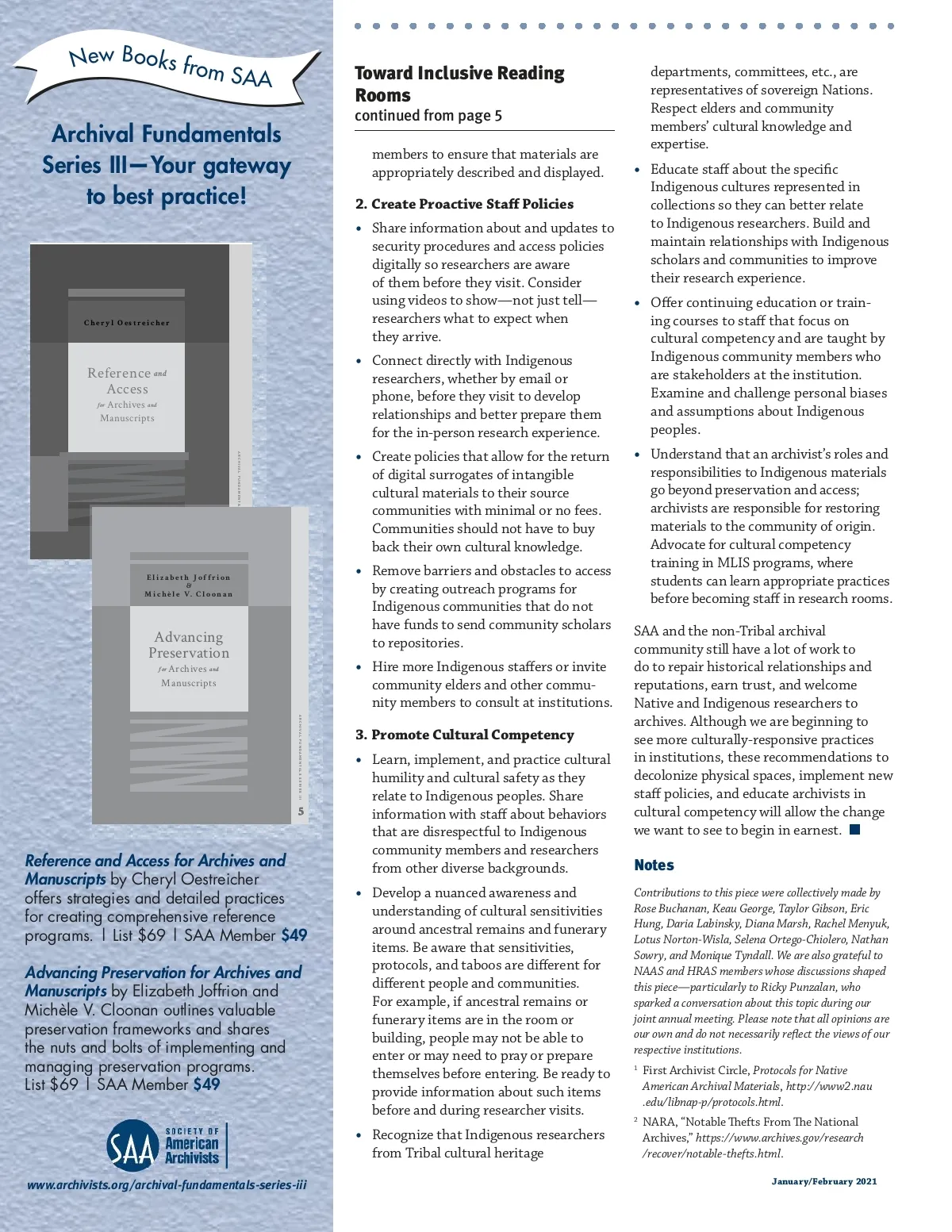
b N ew Books from SAA Toward Inclusive Reading Rooms continued from page 5 members to ensure that materials are appropriately described and displayed. 2. Create Proactive Staff Policies t Share information about and updates to security procedures and access policies digitally so researchers are aware of them before they visit. Consider using videos to show—not just tell— researchers what to expect when they arrive. t Connect directly with Indigenous researchers, whether by email or phone, before they visit to develop relationships and better prepare them for the in-person research experience. t Create policies that allow for the return of digital surrogates of intangible cultural materials to their source communities with minimal or no fees. Communities should not have to buy back their own cultural knowledge. t Remove barriers and obstacles to access by creating outreach programs for Indigenous communities that do not have funds to send community scholars to repositories. t Hire more Indigenous staffers or invite community elders and other commu-nity members to consult at institutions. Archival Fundamentals Series III — Your gateway to best practice! departments, committees, etc., are representatives of sovereign Nations. Respect elders and community members’ cultural knowledge and expertise. t Educate staff about the specific Indigenous cultures represented in collections so they can better relate to Indigenous researchers. Build and maintain relationships with Indigenous scholars and communities to improve their research experience. t Offer continuing education or train-ing courses to staff that focus on cultural competency and are taught by Indigenous community members who are stakeholders at the institution. Examine and challenge personal biases and assumptions about Indigenous peoples. t Understand that an archivist’s roles and responsibilities to Indigenous materials go beyond preservation and access; archivists are responsible for restoring materials to the community of origin. Advocate for cultural competency training in MLIS programs, where students can learn appropriate practices before becoming staff in research rooms. SAA and the non-Tribal archival community still have a lot of work to do to repair historical relationships and reputations, earn trust, and welcome Native and Indigenous researchers to archives. Although we are beginning to see more culturally-responsive practices in institutions, these recommendations to decolonize physical spaces, implement new staff policies, and educate archivists in cultural competency will allow the change we want to see to begin in earnest. Cher yl Oestreicher Reference and Access for Archives and Manuscripts 4 Elizabeth Joffrion & Michèle V. Cloonan ARCHIVAL FUNDAMENTALS AL LS S SE SERIES RIES I III II Advancing Preservation for Archives and Manuscripts Reference and Access for Archives and Manuscripts by Cheryl Oestreicher offers strategies and detailed practices for creating comprehensive reference programs. | List $69 | SAA Member $49 Advancing Preservation for Archives and Manuscripts by Elizabeth Joffrion and Michèle V. Cloonan outlines valuable preservation frameworks and shares the nuts and bolts of implementing and managing preservation programs. List $69 | SAA Member $49 www.archivists.org/archival-fundamentals-series-iii ARCHIVAL FUNDAMENTALS SERIES III 3. Promote Cultural Competency t Learn, implement, and practice cultural humility and cultural safety as they relate to Indigenous peoples. Share information with staff about behaviors that are disrespectful to Indigenous community members and researchers from other diverse backgrounds. t Develop a nuanced awareness and understanding of cultural sensitivities around ancestral remains and funerary items. Be aware that sensitivities, protocols, and taboos are different for different people and communities. For example, if ancestral remains or funerary items are in the room or building, people may not be able to enter or may need to pray or prepare themselves before entering. Be ready to provide information about such items before and during researcher visits. t Recognize that Indigenous researchers from Tribal cultural heritage 5 Notes Contributions to this piece were collectively made by Rose Buchanan, Keau George, Taylor Gibson, Eric Hung, Daria Labinsky, Diana Marsh, Rachel Menyuk, Lotus Norton-Wisla, Selena Ortego-Chiolero, Nathan Sowry, and Monique Tyndall. We are also grateful to NAAS and HRAS members whose discussions shaped this piece—particularly to Ricky Punzalan, who sparked a conversation about this topic during our joint annual meeting. Please note that all opinions are our own and do not necessarily reflect the views of our respective institutions. 1 First Archivist Circle, Protocols for Native American Archival Materials , http://www2.nau .edu/libnap-p/protocols.html . NARA, “Notable Thefts From The National Archives,” https://www.archives.gov/research /recover/notable-thefts.html . January/February 2021 2
Archival Outlook January/February 2021: Page 14